Treatments
Rhinoplasty
A nose no one notices first
A good nose does not stand out. We first measure how the forehead, eyes and lips sit in relation to one another, and only then decide where the nose belongs.

Where the doctor began
A principle learned in ENT.
From my very first days as an ENT resident I was taught that the beauty of the nose and its function must be considered together. Meeting patients who struggled not only with the shape after surgery but with breathing itself, I came to believe that trends may change but the principle of protecting nasal function must not. I will examine your condition precisely and propose a direction where beauty and function stay in balance.
Surgeon
Hong Soon-be
Board-certified ENT specialist · PhD coursework completed Clinical Advisor & Adjunct Professor, ENT, Asan Medical Center
2 papers on empty nose syndrome · 1 on tip cartilage grafting 12 papers in international journals
About the doctor →
Our principle
Before deciding on shape, we look at the airway.
Breathing should feel natural for everyone.
The nose sits at the centre of the face and is also the passage air moves through. Change only the outside without looking at the inner structure, and even good surgery does not last.
SOON BE began in ENT. We do not treat nasal function lightly.
RHINOPLASTY
A good nose is one no one notices first
Instead of looking at the nose alone, we begin with how it balances with the forehead, eyes and lips. We find the line where the front view and the profile agree with each other.

Balance
We start from the whole face, not from the nose alone.

Angle
We design so the front view and the profile do not contradict each other.

Time
We plan for how it will look after the swelling settles.
Scope
Six starting points
No two rhinoplasties begin from the same place.
We decide together where yours begins.
Low bridge
Before the height of the bridge, we look at the angle of the line running from forehead to tip.
Dorsal hump
How the remaining width is handled after the hump is reduced matters more than the reduction itself.
Bulbous tip
The method changes depending on whether cartilage shape, skin thickness or alar width is the cause.
Deviated nose
When the outside looks bent, the septum inside is often bent too. We assess it alongside your breathing.
Revision rhinoplasty
Most of the consultation goes to establishing what was placed in the previous surgery and what remains.
Functional rhinoplasty
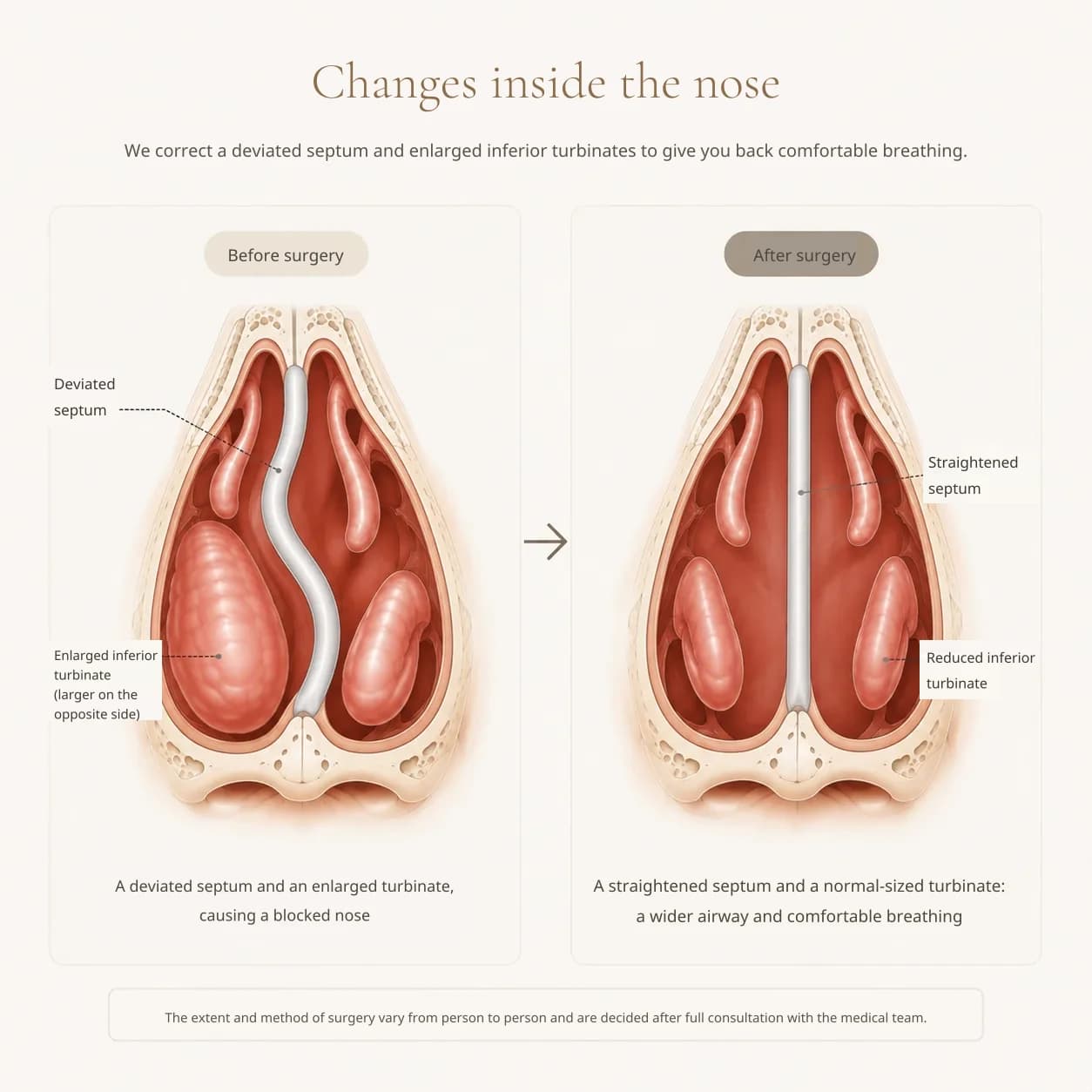
When a deviated septum or rhinitis makes breathing difficult, we plan the functional correction and the shape as one.
Process
What happens before surgery
The doctor conducts every consultation personally. We do not ask you to decide in the consulting room.
Consultation with the doctor
We start by hearing what bothers you now. If you have photos or references, we look at them together.
Structural check
We examine the inside with a nasal endoscope, and use CT where needed to check the septum and rhinitis.
What is possible
What can be done, what cannot, and what may remain — all explained in the same sitting.
Decide at home
We don’t recommend booking on the day of the consultation. Take the explanation home, think it over, then decide.
Recovery
Returning to
everyday life
These are averages and vary widely between people.
We won’t shorten them to reassure you.
Day of surgery — day 1
Splint · internal packing
You will breathe through your mouth. This is the most uncomfortable period.
Days 5 — 7
Splint off · sutures out
The nose at this point is not its final shape. Swelling is at its peak.
Weeks 2 — 3
Back to daily life
People close to you will notice. This is not yet the stage where nothing shows.
Months 3 — 6
Most swelling gone
The tip settles last. The thicker the skin, the longer it takes.
1 year —
Final shape
Revision cases or those using autologous rib cartilage can take longer.

Risks and limits
What to know
before surgery
We write this as large as the good news.
Nothing here is in small print.
Swelling and bruising
Everyone gets them. Only the speed at which they fade differs.
Reduced sensation
The tip may feel numb for several months. It usually recovers, but it takes time.
Asymmetry
Perfect symmetry cannot be created. No face is symmetrical to begin with.
Implant-related changes
Contracture, show-through, displacement or inflammation can appear years later.
Nasal obstruction
Breathing can still feel restricted after the swelling goes down. That is why we examine the inside beforehand.
Possibility of revision
The result may differ from what you expected, and further surgery may be needed.
Pricing
Flawless work, fairly priced
Rhinoplasty covers a different range depending on where it starts, so it cannot be written as a single figure. But we won’t leave you in the dark before the consultation.
Standard prices are posted per item in advance, and once the plan is set in consultation we tell you the total on the spot.
Non-covered fees are posted under Article 45 of the Medical Service Act.






Consultation
Start with whatever is on your mind
You can decide later.
It is fine to come today just to talk.